If you have a website for your business, you have probably heard plenty about SEO. Search Engine Optimisation has been a key part of getting websites found on Google for many years.
But search is changing.
People are increasingly asking AI tools questions rather than simply typing keywords into Google. Tools such as ChatGPT, Google AI Overviews, and Gemini can now provide answers, recommendations and summaries based on information they find across the web.
So, as website and graphic designers, we are starting to think about something else when we build and update websites: how easy is it for AI to understand your business and use your website as a reliable source of information?
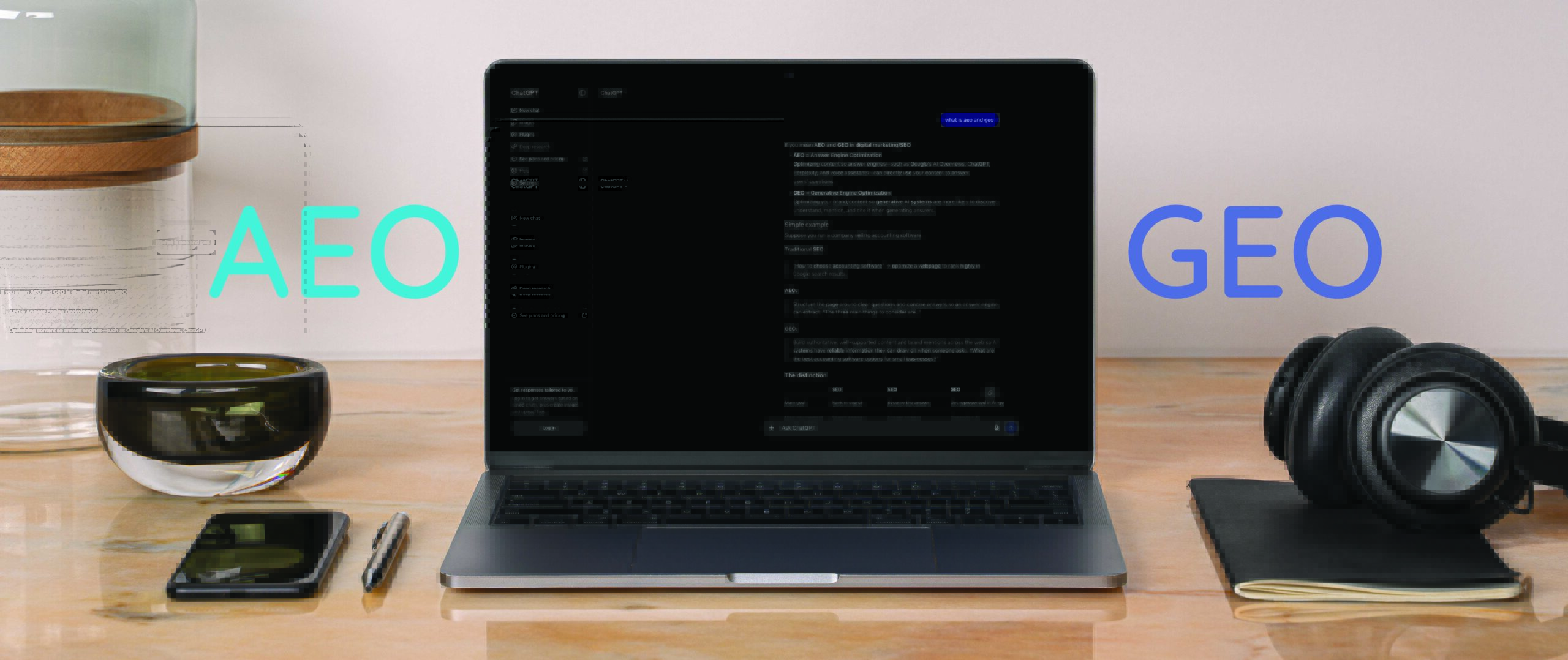
This is where two terms you may have come across, AEO and GEO, enter the conversation.
What is AEO?
AEO stands for Answer Engine Optimisation.
In simple terms, AEO is about structuring your website content so that AI-powered answer engines can easily understand it and potentially use it when answering someone’s question.
Traditional SEO might focus on a search such as:
“Web designers in Somerset”
AEO is more concerned with the type of question someone might ask an AI assistant:
“Can you recommend a web designer in Somerset for a small business?”
Or:
“How much does a professional business website cost?”
The aim is to make sure your website contains clear, useful and trustworthy information that can help answer these sorts of questions.
And what is GEO?
GEO stands for Generative Engine Optimisation.
GEO is a broader term for optimising your online presence so that your business and its content have a better chance of being understood, referenced or surfaced by generative AI systems.
You’ll often see AEO and GEO used interchangeably, and there isn’t one universally agreed distinction between the two terms. In practical terms, both are concerned with the same big change: making your website useful and understandable not only to search engines, but also to the AI systems increasingly being used to find information.
So, rather than thinking of AEO and GEO as completely new replacements for SEO, I think it’s more useful to think of them as another consideration within modern website optimisation.
How can we optimise your website for AEO and GEO?
This is where things get interesting.
AEO and GEO are still relatively new areas of website optimisation. The technology is developing quickly, the way AI systems find and interpret information is changing, and there isn’t a simple checklist that guarantees your business will appear in an AI-generated answer.
That means getting it right can take a bit of work.
It isn’t a case of adding one piece of text to your website and suddenly appearing in ChatGPT or Google’s AI results. Instead, it’s about looking at your website as a whole and making sure the information, structure, content and technical foundations are as clear and useful as possible.
When we are working on a website, there are several areas we can look at.
1. Understanding what your customers are asking
The first step is to understand the questions your potential customers are actually asking.
Instead of only targeting a phrase such as:
“Web designer Somerset”
we can build content around questions such as:
“What should I look for in a web designer?”
“How long does it take to build a business website?”
“Do I need a website if I already have social media?”
By answering genuine questions clearly, we give both potential customers and AI systems useful information to work with.
2. Making your website content clear and specific
AI needs to understand exactly what your business does.
We can review your website and make sure important information is clearly explained, including:
- What services you offer
- Who you work with
- Where you are based
- The areas you cover
- What makes your business different
- Your experience and expertise
- The types of projects you undertake
- How customers can contact you
This might sound obvious, but many websites make visitors work surprisingly hard to find this information.
Clear content is good for people, and it also makes it easier for search engines and AI systems to understand your business.
3. Creating useful, original content
One of the most valuable things we can do is create content that demonstrates your knowledge and experience.
This could include:
- Helpful blog posts
- Frequently asked questions
- Service guides
- Case studies
- Project pages
- Industry information
- Explanations of your products or services
The important thing is that it should be genuinely useful and specific to your business.
For example, a local builder could write about the planning process for a home extension. A photographer could explain what to expect from a business photoshoot.
This gives AI systems much more useful information to understand and potentially reference when people ask relevant questions.
4. Showing your experience and expertise
Don’t just tell people you’re good at what you do. Show them.
Case studies are particularly useful here.
Rather than simply saying:
“We provide professional website design.”
we can show a real project, explain the client’s requirements, describe the solution and demonstrate the finished result.
This creates useful, original information about your business that isn’t available on hundreds of other websites.
5. Improving the structure of your website
Good website structure is important for both humans and machines.
We can look at your:
- Page structure
- Headings
- Navigation
- Internal links
- Service pages
- FAQs
- Meta information
- Image descriptions
- Structured data
- Mobile experience
The aim is to make the website easy to understand and navigate. A page shouldn’t just look good. It should also make sense.
6. Making sure your technical foundations are right
AEO and GEO don’t replace traditional SEO.
Your website still needs to be technically sound.
That means making sure pages can be crawled and indexed, the website works properly on mobile devices, pages load efficiently and important information is accessible.
We can also make sure your structured data is being used appropriately and accurately reflects the information on your website.
These aren’t flashy AI tricks. They’re the foundations of having a good website in the first place.
It’s going to take some experimentation
This is perhaps the most important thing to understand about AEO and GEO.
We’re still learning.
Search engines and AI platforms are changing rapidly. The way they interpret websites today may not be exactly the same six months or a year from now.
So, rather than promising a quick fix, I think it’s better to approach AI optimisation as an ongoing process.
We can make sensible improvements, monitor how your website performs, look at the questions people are searching for, review the content and continue refining it. There will inevitably be some trial and error while this area develops.
That’s not necessarily a bad thing. It means we have an opportunity to experiment and learn what works for different businesses and different types of content.
SEO, AEO and GEO: what’s the difference?
If you’re getting confused by all the terminology, here’s my simple way of looking at it:
| Optimisation | What it means | Main focus |
|---|---|---|
| SEO | Search Engine Optimisation | Helping your website appear in search results |
| AEO | Answer Engine Optimisation | Making your content useful for answering questions |
| GEO | Generative Engine Optimisation | Optimising your online presence for generative AI experiences |
There is a lot of overlap between all three.
You don’t necessarily need to choose one over another. In fact, a well-built website should bring all three approaches together.
Don’t design your website around AI. Design it for your customers.
AI search is developing incredibly quickly, and nobody can guarantee that a particular page will be cited by ChatGPT, appear in an AI Overview or be mentioned by another generative search engine.
What we can control is the quality of your website.
Make it useful and clear.
Make it easy to navigate.
Answer the questions your customers are asking.
Show your experience.
Keep the technical foundations in good shape.
And make sure your branding and visual identity communicate your business professionally.
As website and graphic designers, that’s where we see the opportunity. AI doesn’t remove the need for good design. If anything, it makes having a clear, well-structured and genuinely useful online presence even more important.
AEO and GEO are new, and we’re still working out exactly where they’re heading. But by building a website with clear information, useful content and strong foundations, we can give your business the best possible starting point as the way people search continues to evolve.
If you’d like to find out how your website could be improved for SEO, AEO and GEO, get in touch and we can take a look at where the opportunities are.